Overview
As Copilot evolved, something unexpected happened. The challenge stopped
being creation and became recall. Users could generate Pages, Images,
Research Reports, and an ever-growing range of AI artefacts, yet those
artefacts lived across different ecosystems, products, and mental models.
Enterprise users had one experience, consumer users had another, and
content made inside Microsoft AI existed separately from content made
inside M365 Copilot.
As Microsoft moved toward a unified One Copilot vision, a
fundamental question emerged.
What happens when millions of users, multiple content ecosystems, and two
fundamentally different Copilot experiences become one?
The answer wasn’t content migration. It was Library
Convergence, a project focused on transforming Library from a
collection of artefacts into the recall system for One Copilot.
The problem
Most AI products are obsessed with helping users create things. Very few
help people find them again. As Copilot expanded, users generated more
and more content across Pages, Images, and Research Reports, while
consumer and enterprise experiences evolved independently, leaving
fragmented ecosystems, inconsistent navigation, and different
expectations around recall.
The problem wasn’t simply organisational. It was cognitive. Users rarely
think “was this generated in MAI or M365?” They think
“I remember creating something. Where is it?” The existing model
asked users to understand Microsoft’s internal product boundaries. The
future experience needed to remove them.
Reframing the opportunity
The initial discussions focused heavily on migration: how content should
move, which artefacts should appear, what ownership models needed to
change. But working through the PRD and the broader convergence strategy,
it became clear the opportunity was larger than moving content from one
place to another. The real opportunity was redefining the role of Library
itself.
Rather than a place where content is stored, we began thinking about
Library as a place where knowledge is remembered. That subtle shift
changed everything.
Library is not a repository. Library is Copilot’s recall system.
The product wasn’t helping people manage files. It was helping people
return to ideas, insights, and work they had already created.
Why Library matters
AI changes the economics of creation. Generating content becomes easier,
faster, and more abundant, and as it does, creation becomes less scarce.
Attention becomes scarce. Memory becomes scarce.
The future challenge wasn’t helping users generate their tenth page. It
was helping them rediscover the one page that mattered six weeks later.
Library Convergence became an investment in a future where
Copilot-generated content stays durable, discoverable, and useful over
time. Where Record focused on capturing knowledge, Library focused on
finding it again. Two sides of the same system.
One Copilot, one Library
The convergence vision was ambitious: a single Library experience serving
enterprise users, consumer users, M365 Copilot users, and MAI Copilot
users alike. Within one experience, people could reach Pages, Images,
Research Reports, Cowork artefacts, and future content types without ever
needing to understand where they originated.
Success wasn’t defined by migration. It was defined by invisibility. The
right experience makes multiple ecosystems feel like one.
My role
As the designer who owned this experience end to end, I drove the mobile
design direction for Library Convergence, partnering closely with product
management and a broad cross-functional team across Product, Engineering,
Design, and Research. My work focused on translating a large strategic
initiative into coherent user experiences.
That spanned information architecture, recall flows, creation entry
points, navigation systems, mobile workflow design, cross-platform
alignment, and future artefact scalability, plus the prototyping and
stakeholder alignment to move it forward. A significant part of the
project was converting platform-level strategy into concrete product
decisions users could actually navigate and understand.
Designing a system, not a feature
Most product work centres on individual experiences. Library Convergence
was different: the challenge was designing a system that could keep
evolving long after the initial release. Pages behave differently from
Images; Research Reports differently from Cowork artefacts; and future
artefact types may behave differently from all of them. Yet users should
never feel that complexity.
So the work centred on designing frameworks rather than destinations: how
artefacts should coexist, how filtering should evolve, how creation should
scale, and what happens when entirely new content categories appear. Those
questions mattered far more than any individual screen.
The shift from search to recall
One of the strongest themes was the distinction between search and recall.
Traditional systems assume users know what they’re looking for. Library
users often don’t. They remember creating something, but not where it
lives, what it was called, when it was made, or which Copilot experience
generated it.
That insight reshaped how we thought about navigation, categorisation, and
retrieval. Instead of optimising around file-management patterns, we
focused on supporting memory retrieval.
How might we help users rediscover knowledge with as little effort as
possible?
Prototyping the future of Library
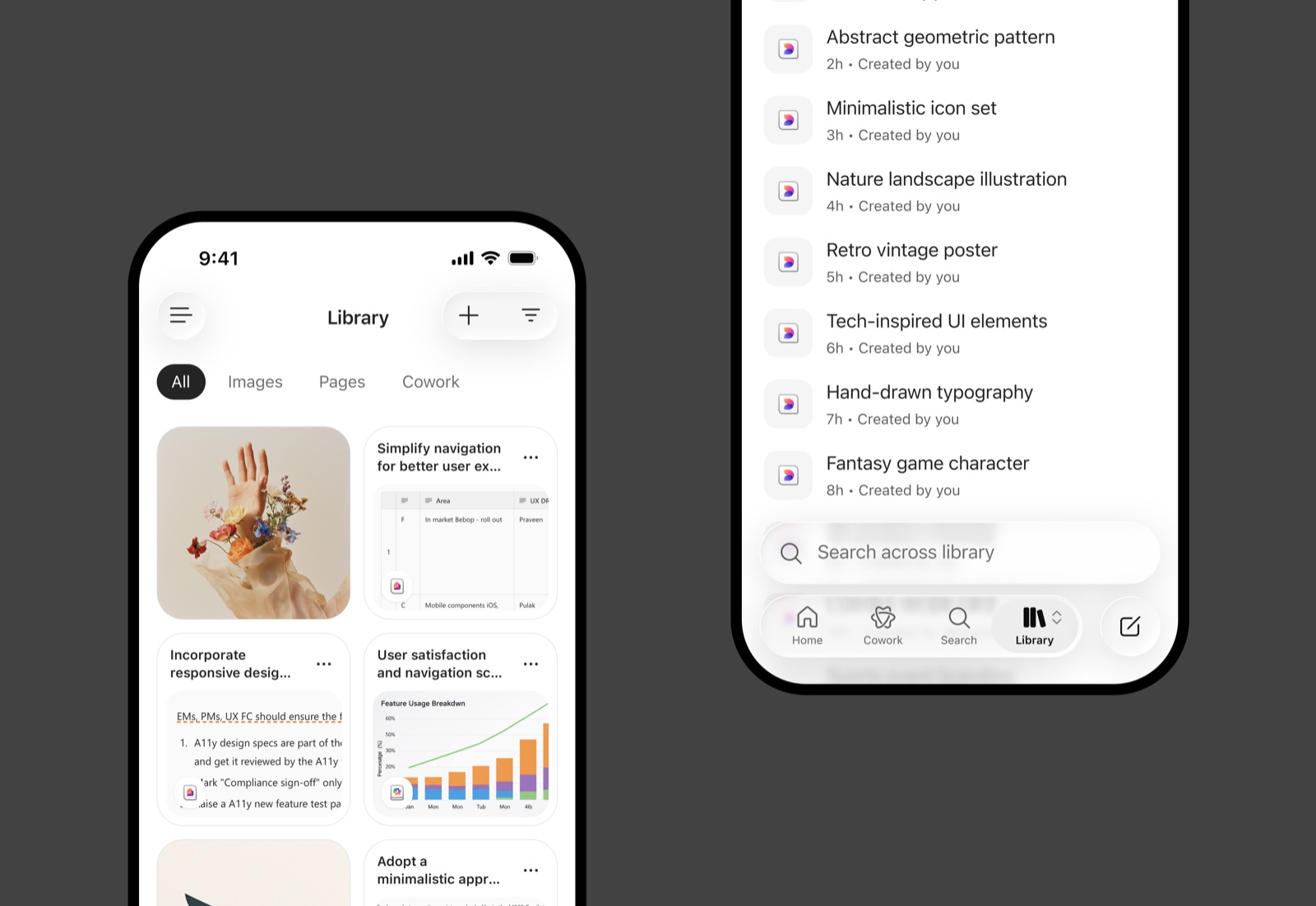
To accelerate alignment and decision-making, I built detailed mobile
workflow prototypes of the converged Library experience, reaching well
beyond happy paths into recall workflows, cross-content navigation, empty
states, creation entry points, future artefact expansion, and
mobile-specific interaction patterns.
Those prototypes became a shared communication tool across Product,
Engineering, and Design, helping teams reason through future directions
before large implementation investments were made.
Outcomes
Library Convergence established the foundation for a unified content
ecosystem across One Copilot. The work helped enable a single Library
experience for consumer and enterprise users, unified recall across
content types, consistent creation entry points, support for Pages,
Images, Research Reports, and Cowork artefacts, future scalability for
emerging content categories, and alignment across mobile, web, and
platform convergence efforts.
Most importantly, it transformed Library from a storage destination into a
core part of the Copilot experience. Not a file browser, not a content
repository, but a memory system for One Copilot.
Reflection
This project reinforced three lessons. First, organisational complexity
often creates product opportunities. What looked like a migration
challenge revealed a much bigger chance to rethink how people interact with
knowledge across the Copilot ecosystem. Second, information architecture
becomes increasingly important as AI systems scale: generating content is
easy; helping people find it again is substantially harder.
Finally, great AI products aren’t defined by individual features. They’re
defined by the systems that help people create, remember, and reuse
knowledge over time. Library was my opportunity to help design one of
those systems. One Copilot, one Library, one place to remember.